


Файл:Vulva symbols.svg


Исходный файл (SVG-файл, номинально 500 × 600 пкс, размер файла: 3 КБ)
Описание
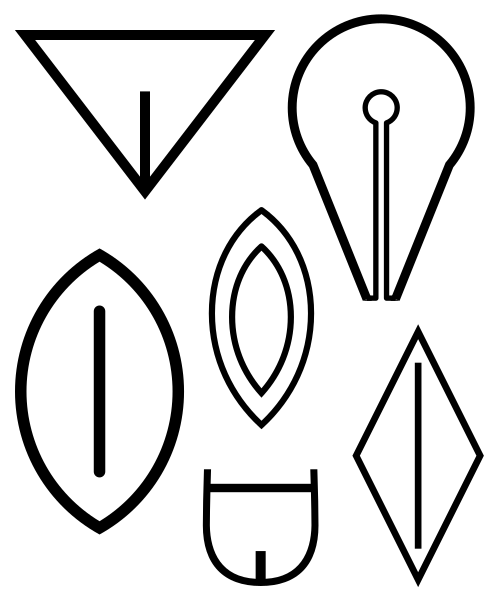
| Описание | Six symbolic abstract representations of external female genitals (i.e. "yonic" symbols) which have been used in various historical/cultural contexts: 1) Upper left: A schematized drawing of the pubic triangle; among other things, this is the earliest archaic form of the ancient Sumerian cuneiform sign MUNUS (meaning "woman"); see Image:Ishtar vase Louvre AO17000-detail.jpg. The later form of this cuneiform sign is no longer pictographic, formed of four wedge shapes: [1] 2) Upper right: A composite version of Hindu Yoni symbols. It combines features of various versions of Indian Yoni symbols (such as the one seen in Image:Lingam.jpg), but this particular shape may not itself be an authentic Hindu symbol. (For a somewhat similar symbol in a non-Hindu context, see Image:Vulve stylisée.JPG .) 3) Lower left: One form of the pointed oval encountered in many contexts as a representation or symbol of the vulva (including as part of medieval Sheela-na-gig figures). This particular version is based on a description in the book "Blood Brothers of Gor", using the geometry of the Vesica Piscis configuration (i.e. the overlap between two circles of equal diameter, where the center of each circle is on the circumference of the other). For one variation of this (a pointed oval within a circle), see Image:Dina-gor.svg or Image:Triple-Goddess-Waxing-Full-Waning-Symbol-multicolored.svg . 4) Center: Oval within oval (another variation of the preceding). 5) Lower center: Quasi-original form of an Egyptian hieroglyph used in the spellings of the ancient Egyptian words for "woman" and "vulva" (according to James P. Allen's Middle Egyptian: An Introduction to the Language and Culture of Hieroglyphs, where it is assigned the number D280a and described as an abstract representation of the pelvis and vulva). In ancient Egyptian inscriptions, this sign is generally merged with or replaced by hieroglyphs N41 <tbody></tbody>
6) Lower right: Czech and Slovak "píča" symbol. The ancient Mesopotamian rhomb or lozenge of Ishtar was similar, but with concentric diamonds (sometimes with slightly rounded corners), instead of a line inside a diamond. See Gods, Demons, and Symbols of Ancient Mesopotamia: An Illustrated Dictionary by Jeremy Black and Anthony Green (1992, ISBN 0-292-70794-0), p. 153. | ||||
|---|---|---|---|---|---|
| Источник | This vector image includes elements that have been taken or adapted from this file: | ||||
| Время создания | 2007 | ||||
| Автор или правообладатель | AnonMoos — Лицензия: Public domain (в общественном достоянии) | ||||
| Другие версии файла | — |

![[1]](https://commons.wikimedia.org/wiki/File:Cuneiform_sal.png)


Источник файла — сайт Wikimedia Commons, куда он был загружен под одной из свободных лицензий ( https://commons.wikimedia.org/wiki/File:Vulva_symbols.svg ). Авторов, работавших над этим файлом см. в истории файла: https://commons.wikimedia.org/w/index.php?title=File:Vulva_symbols.svg&action=history


В общем случае в статьях энциклопедии Руниверсалис файлы используются в соответствии со статьёй 1274 Гражданского кодекса Российской Федерации.
История файла
Нажмите на дату/время, чтобы увидеть версию файла от того времени.
| Дата/время | Миниатюра | Размеры | Участник | Примечание | |
|---|---|---|---|---|---|
| текущий | 04:00, 4 сентября 2023 | | 500 × 600 (3 КБ) | I, Robot (обсуждение | вклад) | == Описание == {{Изображение | описание = <p>Six symbolic abstract representations of external female genitals (i.e. "yonic" symbols) which have been used in various historical/cultural contexts: </p><p>1) Upper left: A schematized drawing of the pubic triangle; among other things, this is the earliest archaic form of the ancient Sumerian cuneiform sign MUNUS (meaning "woman"); see [https://commons.wikimedia.org/wiki/File:Ishtar_vase_Louvre_AO17000-detail.jpg Image:Ishtar vase Louvre AO17000... |
Вы не можете перезаписать этот файл.
Использование файла
Следующий файл является дубликатом этого файла (подробности):

- Файл:Vulva symbols.svg на Викискладе
Следующие 2 страницы используют этот файл:
