Материал из энциклопедии Руниверсалис
Исходный файл (657 × 650 пкс, размер файла: 13 КБ, MIME-тип: image/jpeg)
Описание
Описание изображения
| Описание
|
From the NASA press release:
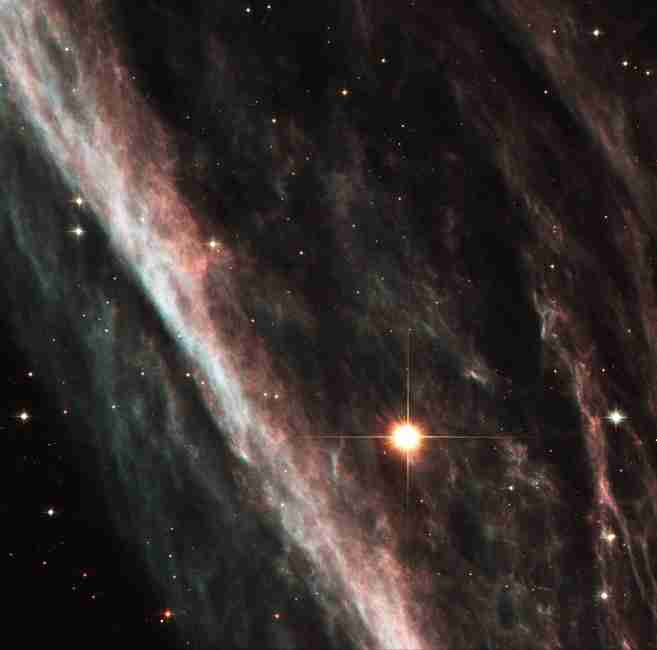
- Remnants from a star that exploded thousands of years ago created a celestial abstract portrait, as captured in this NASA Hubble Space Telescope image of the Pencil Nebula.
- Officially known as NGC 2736, the Pencil Nebula is part of the huge Vela supernova remnant, located in the southern constellation Vela. Discovered by Sir John Herschel in the 1840s, the nebula's linear appearance triggered its popular name. The nebula's shape suggests that it is part of the supernova shock wave that recently encountered a region of dense gas. It is this interaction that causes the nebula to glow, appearing like a rippled sheet.
- In this snapshot, astronomers are looking along the edge of the undulating sheet of gas. This view shows large, wispy filamentary structures, smaller bright knots of gas, and patches of diffuse gas. The Hubble Heritage Team used the Advanced Camera for Surveys in October 2002 to observe the nebula. The region of the Pencil Nebula captured in this image is about three fourths of a light-year across. The Vela supernova remnant is 114 light-years (35 parsecs) across. The remnant is about 815 light-years (250 parsecs) away from our solar system.
- The nebula's luminous appearance comes from dense gas regions that have been struck by the supernova shock wave. As the shock wave travels through space [from right to left in the image], it rams into interstellar material. Initially the gas is heated to millions of degrees, but then subsequently cools down, emitting the optical light visible in the image.
- The colors of the various regions in the nebula yield clues about this cooling process. Some regions are still so hot that the emission is dominated by ionized oxygen atoms, which glow blue in the picture. Other regions have cooled more and are seen emitting red in the image (cooler hydrogen atoms). In this situation, color shows the temperature of the gas. The nebula is visible in this image because it is glowing.
- The supernova explosion left a spinning pulsar at the core of the Vela region. Based on the rate at which the pulsar is slowing down, astronomers estimate that the explosion may have occurred about 11,000 years ago. Although no historical records of the blast exist, the Vela supernova would have been 250 times brighter than Venus and would have been easily visible to southern observers in broad daylight. The age of the blast, if correct, would imply that the initial explosion pushed material from the star at nearly 22 million miles per hour. As the Vela supernova remnant expands, the speed of its moving filaments, such as the Pencil Nebula, decreases. The Pencil Nebula, for example, is moving at roughly 400,000 miles per hour.
|
| Источник
|
http://hubblesite.org/newscenter/archive/releases/2003/16/image/a (direct link)
|
| Время создания
|
June 5 2003
|
| Автор или правообладатель
|
NASA and The Hubble Heritage Team (STScI/AURA) — Лицензия: Public domain (в общественном достоянии)
|
| Другие версии файла
|
—
|
Источник файла — сайт Wikimedia Commons, куда он был загружен под одной из свободных лицензий ( https://commons.wikimedia.org/wiki/File:Pencil_hst_big.jpg ). Авторов, работавших над этим файлом см. в истории файла: https://commons.wikimedia.org/w/index.php?title=File:Pencil_hst_big.jpg&action=history
В общем случае в статьях энциклопедии Руниверсалис файлы используются в соответствии со статьёй 1274 Гражданского кодекса Российской Федерации.
История файла
Нажмите на дату/время, чтобы увидеть версию файла от того времени.
| Дата/время | Миниатюра | Размеры | Участник | Примечание |
|---|
| текущий | 10:19, 31 августа 2023 |  | 657 × 650 (13 КБ) | Я, робот (обсуждение | вклад) | == Описание == {{Изображение | описание = <p>From the NASA press release: </p> <dl><dd>Remnants from a star that exploded thousands of years ago created a celestial abstract portrait, as captured in this NASA Hubble Space Telescope image of the Pencil Nebula.</dd></dl><dl><dd>Officially known as [https://en.wikipedia.org/wiki/NGC_2736 NGC 2736], the Pencil Nebula is part of the huge Vela supernova remnant, located in the southern constellation Vela. Discovered by Sir John Herschel in the 184... |
Вы не можете перезаписать этот файл.
Использование файла
Следующие 2 страницы используют этот файл: