


Файл:NGC 3021 Hubble.jpg

Исходный файл (1470 × 1695 пкс, размер файла: 207 КБ, MIME-тип: image/jpeg)
Описание
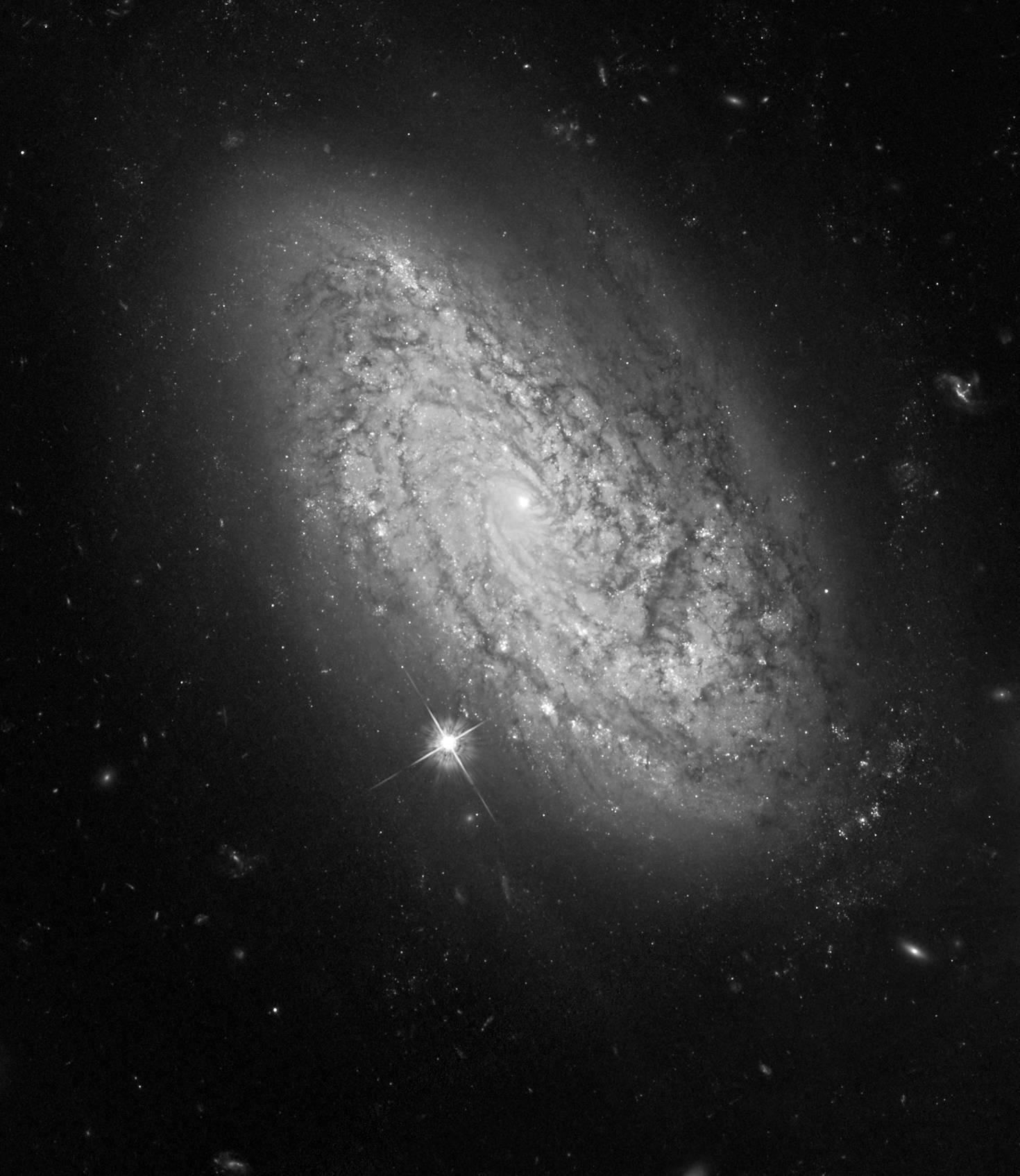
| Описание | Less than 100 years ago scientists didn't know if the universe was coming or going, literally. It even fooled the great mind of Albert Einstein. He assumed the universe must be static. But to keep the universe from collapsing under gravity like a house of cards, Einstein hypothesized there was a repulsive force at work, called the cosmological constant, that counterbalanced gravity's tug. Along came Edwin Hubble in 1923 who found that galaxies were receding from us at a proportional rate, called the Hubble constant, which meant the universe was uniformly expanding, so there was no need to shore it up with any mysterious force from deep space. In measuring how this expansion was expected to slow down over time, 11 years ago, two studies, one led by Adam Riess of the Space Telescope Science Institute and the Johns Hopkins University and Brian Schmidt of Mount Stromlo Observatory, and the other by Saul Perlmutter of Lawrence Berkeley National Laboratory, independently discovered dark energy, which seems to behave like Einstein's cosmological constant.
To better characterize dark energy, Riess used Hubble Space Telescope's crisp view (combined with 2003 data from NASA's Wilkinson Microwave Anisotropy Probe, WMAP) to refine the value of the universe's expansion rate to a precision of three percent. That's a big step from 20 years ago when astronomers' estimates for the Hubble constant disagreed by a factor of two. This new value implies that dark energy really is a steady push on the universe as Einstein imagined, rather than something more effervescent (like the early inflationary universe) that changes markedly over time. Data from several HST proposals were used for this science. These include: 9352, 9728, 10189, 10339, and 10802, PI: A. Riess (STScI/JHU). Data specific to observations of NGC 3021 are from HST proposals 10802 and 10497 PI: A. Riess (STScI/JHU). The science team includes: A. Riess (STScI/JHU), L. Macri (Texas A&M University), S. Casertano and M. Sosey (STScI), H. Lampeitl (STScI/University of Portsmouth, UK), H. Ferguson (STScI), A. Filippenko (University of California, Berkeley), S. Jha (Rutgers University), W. Li and R. Chornock (University of California, Berkeley), and D. Sarkar (University of California, Irvine). |
|---|---|
| Источник | http://hubblesite.org/newscenter/archive/releases/2009/08/image/b/ |
| Время создания | November 2005 - November 2006 |
| Автор или правообладатель | NASA, ESA, and A. Riess (STScI/JHU) — Лицензия: Public domain (в общественном достоянии) |
| Другие версии файла | — |
Источник файла — сайт Wikimedia Commons, куда он был загружен под одной из свободных лицензий ( https://commons.wikimedia.org/wiki/File:NGC_3021_Hubble.jpg ). Авторов, работавших над этим файлом см. в истории файла: https://commons.wikimedia.org/w/index.php?title=File:NGC_3021_Hubble.jpg&action=history


В общем случае в статьях энциклопедии Руниверсалис файлы используются в соответствии со статьёй 1274 Гражданского кодекса Российской Федерации.
История файла
Нажмите на дату/время, чтобы увидеть версию файла от того времени.
| Дата/время | Миниатюра | Размеры | Участник | Примечание | |
|---|---|---|---|---|---|
| текущий | 22:16, 20 ноября 2023 | | 1470 × 1695 (207 КБ) | I, Robot (обсуждение | вклад) | == Описание == {{Изображение | описание = Less than 100 years ago scientists didn't know if the universe was coming or going, literally. It even fooled the great mind of Albert Einstein. He assumed the universe must be static. But to keep the universe from collapsing under gravity like a house of cards, Einstein hypothesized there was a repulsive force at work, called the cosmological constant, that counterbalanced gravity's tug. Along came Edwin Hubble in 1923 who found that galaxies were r... |
Вы не можете перезаписать этот файл.
Использование файла
Следующая страница использует этот файл:
