


Файл:Messier85 - HST - Potw1905a.jpg


Исходный файл (3088 × 3263 пкс, размер файла: 105 КБ, MIME-тип: image/jpeg)
Описание
| Описание | The darkness within?
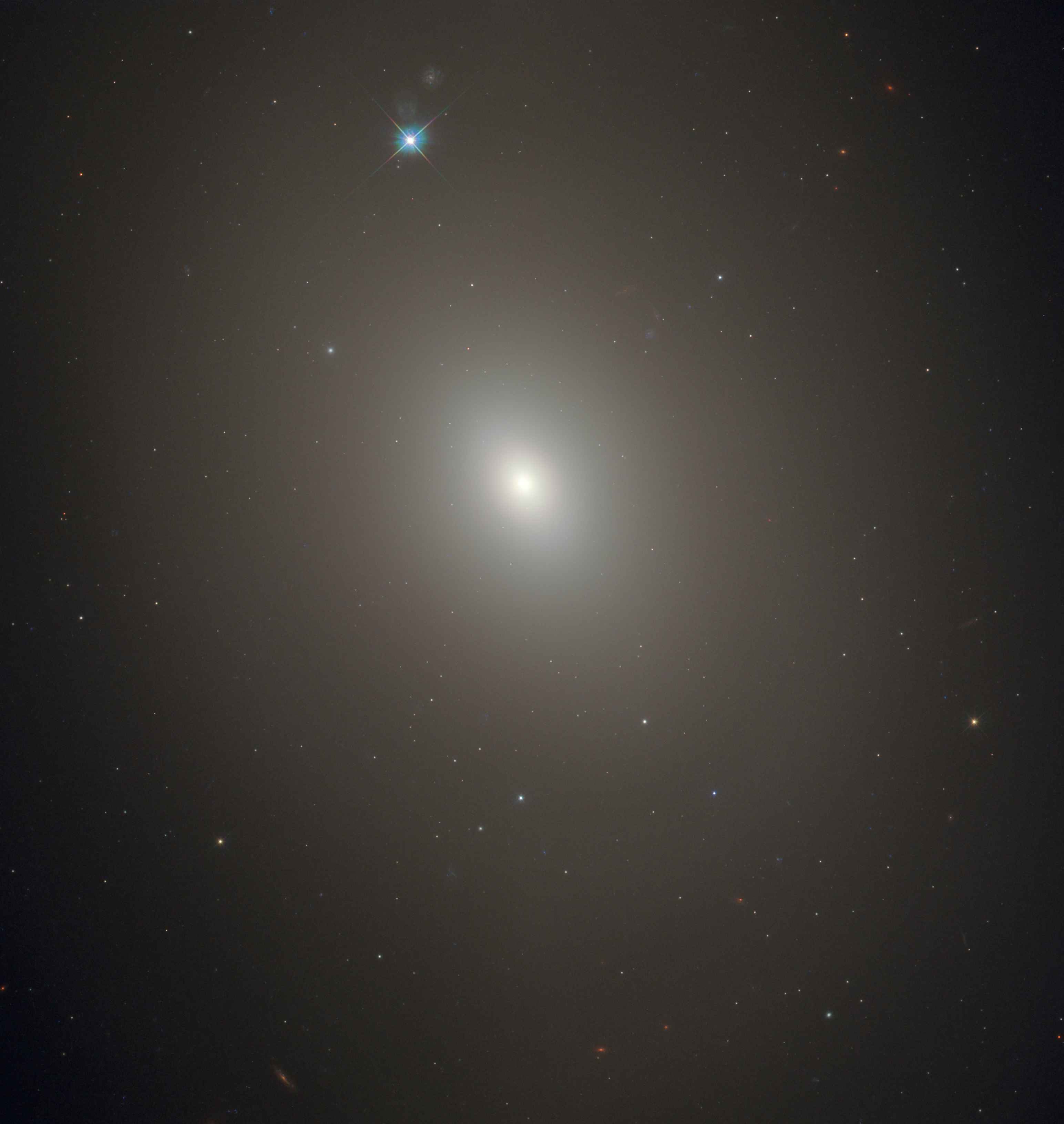
This atmospheric image shows a galaxy named Messier 85, captured in all its delicate, hazy glory by the NASA/ESA Hubble Space Telescope. Messier 85 slants through the constellation of Coma Berenices (Berenice’s Hair), and lies around 50 million light-years from Earth. It was first discovered by Charles Messier’s colleague Pierre Méchain in 1781, and is included in the Messier catalogue of celestial objects. Messier 85 is intriguing — its properties lie somewhere between those of a lenticular and an elliptical galaxy, and it appears to be interacting with two of its neighbours: the beautiful spiral NGC 4394, located out of frame to the upper left, and the small elliptical MCG 3-32-38, located out of frame to the centre bottom. The galaxy contains some 400 billion stars, most of which are very old. However, the central region hosts a population of relatively young stars of just a few billion years in age; these stars are thought to have formed in a late burst of star formation, likely triggered as Messier 85 merged with another galaxy over four billion years ago. Messier 85 has a further potentially strange quality. Almost every galaxy is thought to have a supermassive black hole at its centre, but from measurements of the velocities of stars in this galaxy, it is unclear whether Messier 85 contains such a black hole. This image combines infrared, visible and ultraviolet observations from Hubble’s Wide Field Camera 3. Credit: ESA/Hubble & NASA, R. O'Connell Coordinates Position (RA): 12 25 24.00 Position (Dec): 18° 11' 16.55" Field of view: 2.55 x 2.69 arcminutes Orientation: North is 0.1° right of vertical Colours & filters Band Wavelength Telescope Optical u 336 nm Hubble Space Telescope WFC3 Optical B 438 nm Hubble Space Telescope WFC3 Optical V 555 nm Hubble Space Telescope WFC3 Optical I 814 nm Hubble Space Telescope WFC3 . |
|---|---|
| Источник | https://www.spacetelescope.org/images/potw1905a/ https://cdn.spacetelescope.org/archives/images/large/potw1905a.jpg |
| Время создания | 4 February 2019, 06:00 (Release) |
| Автор или правообладатель | Credit: ESA/Hubble & NASA, R. O'Connell — Лицензия: CC BY 4.0 (Creative Commons Attribution 4.0) https://creativecommons.org/licenses/by/4.0 |
| Другие версии файла | — |

Источник файла — сайт Wikimedia Commons, куда он был загружен под одной из свободных лицензий ( https://commons.wikimedia.org/wiki/File:Messier85_-_HST_-_Potw1905a.jpg ). Авторов, работавших над этим файлом см. в истории файла: https://commons.wikimedia.org/w/index.php?title=File:Messier85_-_HST_-_Potw1905a.jpg&action=history


В общем случае в статьях энциклопедии Руниверсалис файлы используются в соответствии со статьёй 1274 Гражданского кодекса Российской Федерации.
История файла
Нажмите на дату/время, чтобы увидеть версию файла от того времени.
| Дата/время | Миниатюра | Размеры | Участник | Примечание | |
|---|---|---|---|---|---|
| текущий | 03:12, 7 ноября 2023 | | 3088 × 3263 (105 КБ) | I, Robot (обсуждение | вклад) | == Описание == {{Изображение | описание = <p><b>The darkness within?</b> </p><p><br/> This atmospheric image shows a galaxy named Messier 85, captured in all its delicate, hazy glory by the NASA/ESA Hubble Space Telescope. Messier 85 slants through the constellation of Coma Berenices (Berenice’s Hair), and lies around 50 million light-years from Earth. It was first discovered by Charles Messier’s colleague Pierre Méchain in 1781, and is included in the Messier catalogue of celestial objects.... |
Вы не можете перезаписать этот файл.
Использование файла
Следующая страница использует этот файл:
