


Файл:Linear accelerator animation 16frames 1.6sec.gif
Linear_accelerator_animation_16frames_1.6sec.gif (800 × 255 пкс, размер файла: 175 КБ, MIME-тип: image/gif, закольцованный, 16 фреймов, 1,6 с)
Описание
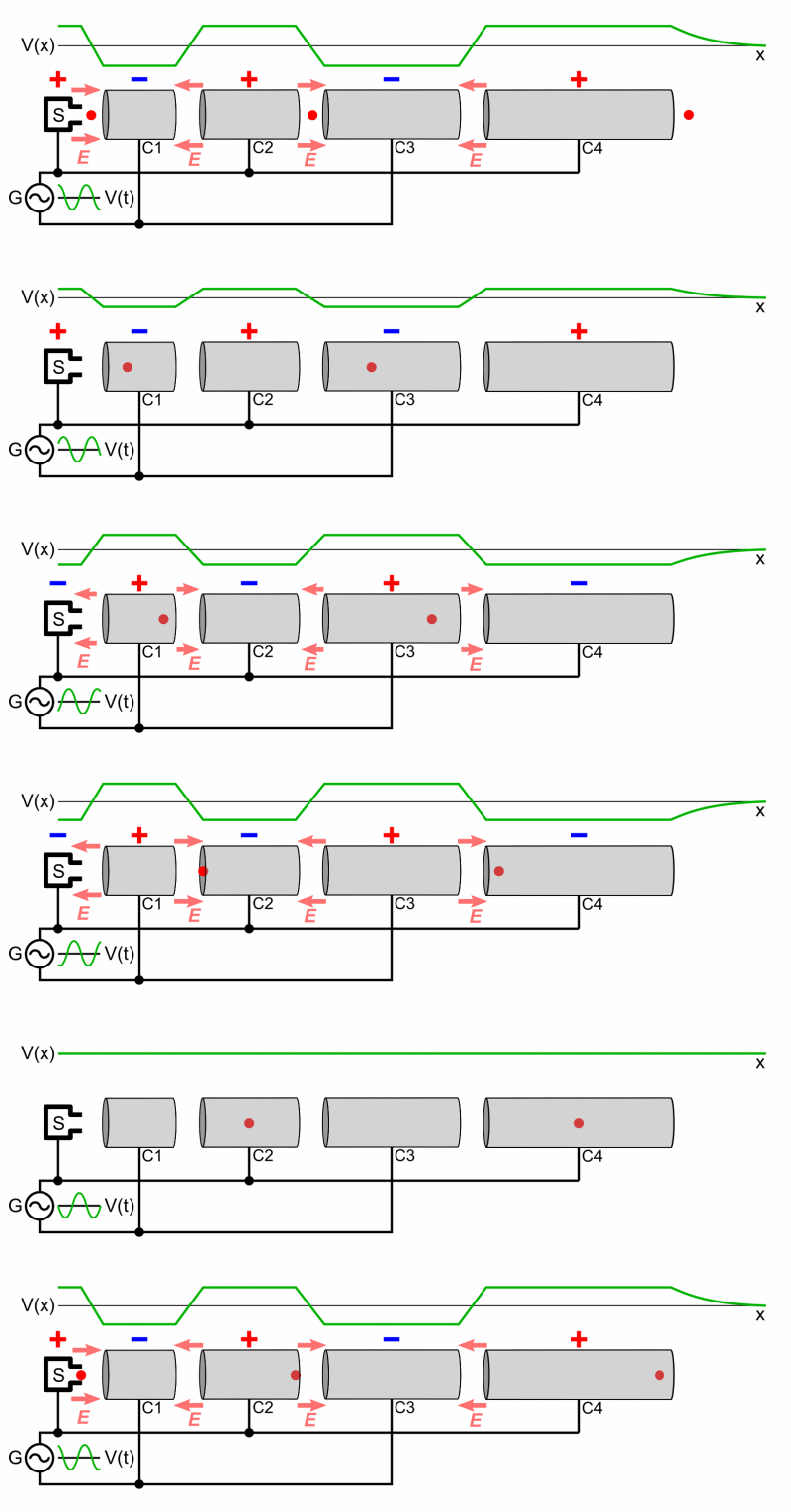
| Описание | Animation illustrating how a linear particle accelerator works. It consists of a particle source (S) which injects particles into a beamline of open-ended cylindrical electrodes (C1, C2, C3, C4) of progressively increasing length. An electronic oscillator and amplifier (G) produces a radio frequency AC voltage of high potential which is applied to the electrodes. Opposite polarity voltage is applied to alternate electrodes, so adjacent electrodes are at opposite voltages. This produces an oscillating electric field (E) in the gaps between electrodes, which exerts force on the particles when they pass through, accelerating them. The particle source injects a group of particles into the first electrode at the correct time so that the polarity of the voltage is opposite to the charge on the particles. The length of the electrodes is calculated so that the particle takes exactly one half cycle of the RF voltage to pass through each electrode. The polarity of the voltage reverses as the particle passes through the electrode so when the particle reaches the gap the field is in the correct direction to accelerate it. This is illustrated by the graph V(x) which shows the electric potential along the accelerator axis and how it changes with time. At the moment the particle passes through the gap between electrodes there is always a drop in potential. In this example it is assumed that the accelerated particles (red dots) have a positive charge. Although the animation shows only one particle being accelerated per cycle, the particle source actually injects many particles each cycle. The accelerator is enclosed in a vacuum tank, which is not shown. The action is shown slowed down enormously; the oscillation frequency of the radio frequency generator (G) is usually in the microwave range, changing polarity billions of times per second. |
|---|---|
| Источник | Own work |
| Время создания | 2018-04-21 |
| Автор или правообладатель | Chetvorno — Лицензия: CC0 (Creative Commons Zero, Public Domain Dedication) http://creativecommons.org/publicdomain/zero/1.0/deed.en |
| Другие версии файла | — |
Источник файла — сайт Wikimedia Commons, куда он был загружен под одной из свободных лицензий ( https://commons.wikimedia.org/wiki/File:Linear_accelerator_animation_16frames_1.6sec.gif ). Авторов, работавших над этим файлом см. в истории файла: https://commons.wikimedia.org/w/index.php?title=File:Linear_accelerator_animation_16frames_1.6sec.gif&action=history


В общем случае в статьях энциклопедии Руниверсалис файлы используются в соответствии со статьёй 1274 Гражданского кодекса Российской Федерации.
История файла
Нажмите на дату/время, чтобы увидеть версию файла от того времени.
| Дата/время | Миниатюра | Размеры | Участник | Примечание | |
|---|---|---|---|---|---|
| текущий | 15:26, 8 ноября 2023 | | 800 × 255 (175 КБ) | Я, робот (обсуждение | вклад) | == Описание == {{Изображение | описание = Animation illustrating how a [https://en.wikipedia.org/wiki/linear_accelerator linear particle accelerator] works. It consists of a particle source <i>(S)</i> which injects particles into a beamline of open-ended cylindrical electrodes <i>(C1, C2, C3, C4)</i> of progressively increasing length. An [https://en.wikipedia.org/wiki/electronic_oscillator electronic oscillator] and [https://en.wikipedia.org/wiki/amplifier amplifier] <i>(G)</i> produces a... |
Вы не можете перезаписать этот файл.
Использование файла
Следующий файл является дубликатом этого файла (подробности):

- Файл:Linear accelerator animation 16frames 1.6sec.gif на общем хранилище
Следующая страница использует этот файл:
