

Файл:LISA-waves.jpg

Исходный файл (1500 × 1125 пкс, размер файла: 165 КБ, MIME-тип: image/jpeg)
Описание
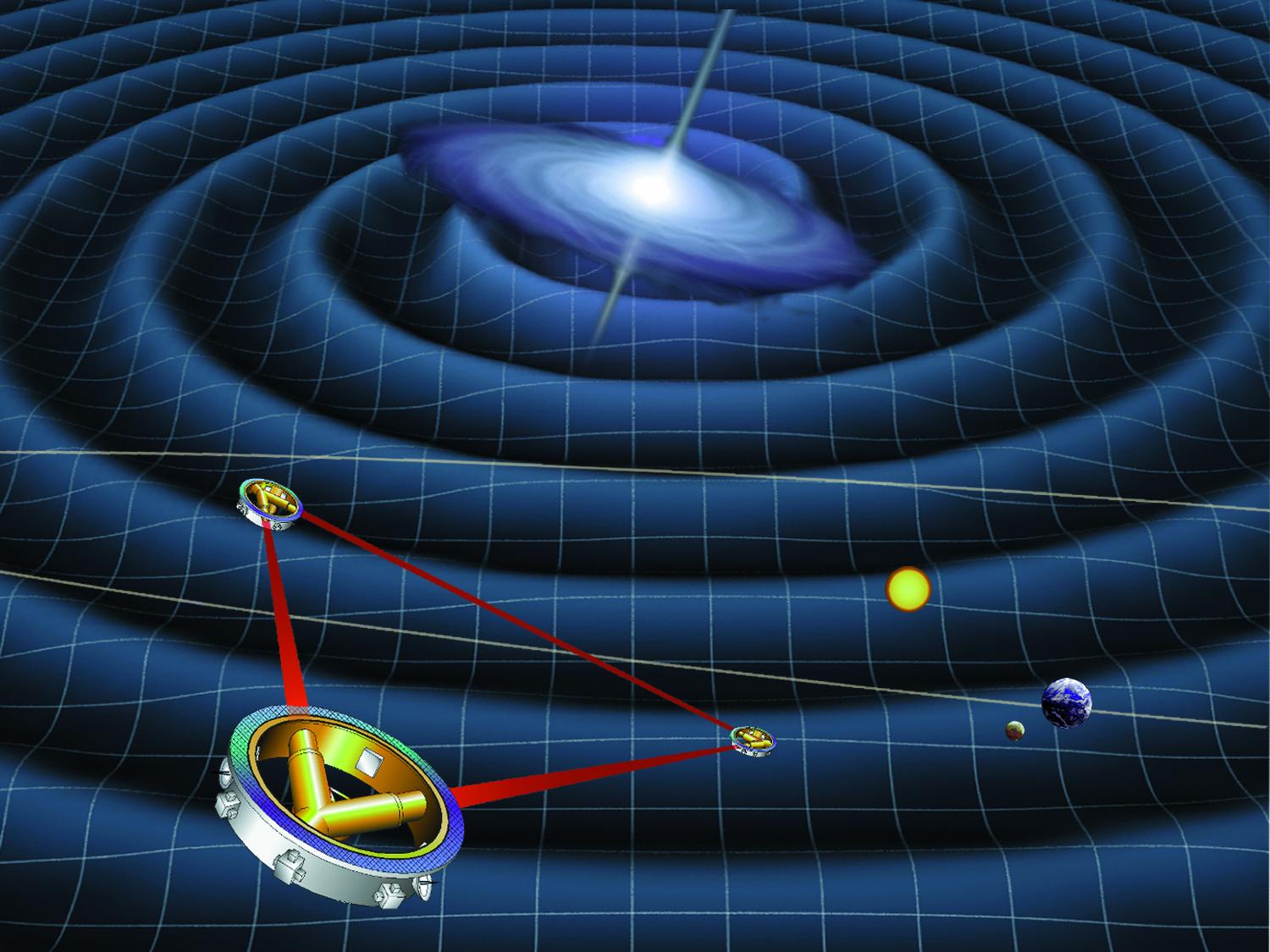
| Описание | NASA illustration of LISA, taken from http://lisa.jpl.nasa.gov/gallery/lisa-waves.html. High resolution TIFF compressed with "cjpeg" from libjpeg-progs.
NASA's description: The three LISA spacecraft will be placed in orbits that form a triangular formation with center 20° behind the Earth and side length 5 million km. (The figure showing the formation is not to scale.) Each spacecraft will be in an individual Earth-like orbit around the Sun. The orbits are chosen to minimize changes in the lengths of the sides of the triangle. The orbits of the three spacecraft have a relationship between inclination and eccentricity that inclines the plane of the formation by 60° with respect to the ecliptic. The nodal longitudes of the three orbits are shifted by 120° to create the triangle. The heliocentric orbit offers a particularly quiet environment, critical for the control of disturbances on the test masses defining the interferometer arms. The test masses are free-falling and shielded by the enclosing spacecraft from disturbances of the solar wind and photon pressure. The orientation of the spacecraft with respect to the Sun changes very slowly. The Sun appears moves along a cone with a 30° half angle aligned with the spacecraft's cylindrical axis once per year, giving constant illumination. The major source of disturbance in the measurement band is the variation in the solar constant caused by the Sun's normal modes of oscillation, amounting to less than 10 ppm in intensity. The orbital motion of the antenna sweeps its sensitivity lobes across the sky, giving an amplitude modulation dependent on a source's angular coordinates. Similarly, the Doppler effect gives a phase modulation dependent on a source's angular coordinates. The two effects combine to give directional information about every source. Most of the sources observable by LISA are periodic or quasi-periodic and can be observed for at least a year. The angular position accuracy depends on the signal-to-noise ratio. For the strongest sources, the direction to the source can be determined to about 1 arc minute. |
|---|---|
| Источник | NASA |
| Время создания | |
| Автор или правообладатель | NASA — Лицензия: Public domain (в общественном достоянии) |
| Другие версии файла | — |
Источник файла — сайт Wikimedia Commons, куда он был загружен под одной из свободных лицензий ( https://commons.wikimedia.org/wiki/File:LISA-waves.jpg ). Авторов, работавших над этим файлом см. в истории файла: https://commons.wikimedia.org/w/index.php?title=File:LISA-waves.jpg&action=history


В общем случае в статьях энциклопедии Руниверсалис файлы используются в соответствии со статьёй 1274 Гражданского кодекса Российской Федерации.
История файла
Нажмите на дату/время, чтобы увидеть версию файла от того времени.
| Дата/время | Миниатюра | Размеры | Участник | Примечание | |
|---|---|---|---|---|---|
| текущий | 06:02, 24 июля 2023 | | 1500 × 1125 (165 КБ) | Я, робот (обсуждение | вклад) | Источник файла — сайт Wikimedia Commons, куда он был загружен под одной из свободных лицензий (актуальные условия использования файла см. по [https://commons.wikimedia.org/wiki/File:LISA-waves.jpg ссылке]). Авторов, работавших над этим файлом см. в [https://commons.wikimedia.org/w/index.php?title=File:LISA-waves.jpg&action=history истории файла], сам файл на Wikimedia Commons загрузил участник [https://commons.wikimedia.org/wiki/User:Carlog3 Carlog3]. В статьях энциклопедии Руниверсалис... |
Вы не можете перезаписать этот файл.
Использование файла
Следующий файл является дубликатом этого файла (подробности):

- Файл:LISA-waves.jpg на Викискладе
Следующая 31 страница использует этот файл:
- ALLEGRO
- AURIGA
- EPTA
- EXPLORER
- Einstein@Home
- GEO600
- GW151226
- GW170104
- GW170814
- GW170817
- GW190521
- INDIGO
- KAGRA
- LIGO
- Laser Interferometer Space Antenna
- MiniGRAIL
- NANOGrav
- NAUTILUS
- TAMA 300
- TOBA
- Virgo (интерферометр)
- Гравитационная антенна
- Гравитационно-волновая астрономия
- Гравитационные волны
- Детектор гравитационных волн
- Марио Шенберг (детектор)
- Открытие гравитационных волн
- Список космических телескопов
- Список наблюдений гравитационных волн
- Телескоп Эйнштейна
- Шаблон:Гравитационные телескопы
