


Файл:G11.2-0.3.jpg
Нет версии с бо́льшим разрешением.
G11.2-0.3.jpg (572 × 540 пкс, размер файла: 172 КБ, MIME-тип: image/jpeg)
Описание
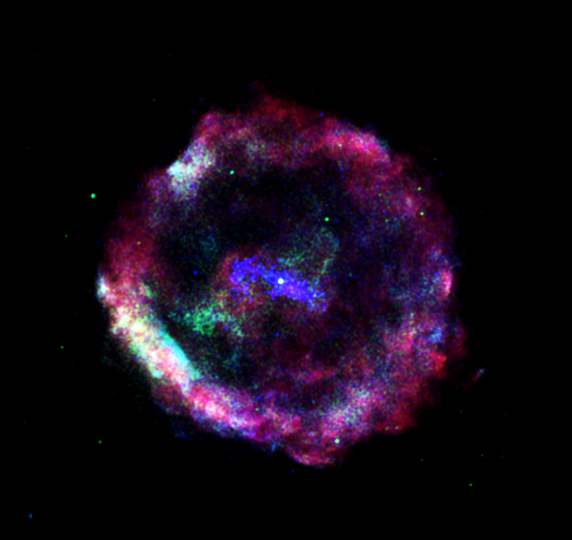
| Описание | G11.2-0.3 is a circularly symmetric supernova remnant that contains a dense, rotating dead star at its center, representing a textbook case of what the remnant of an exploding star should look like after a couple thousand years. When a massive star collapses, the outer layers of the star are blown away in an extremely energetic explosion. Depending on the mass of the original star, a dense object such as a neutron star or a black hole, can form and be left behind at the explosion's center. Such a neutron star, known as a "pulsar" when it rapidly rotates, can be kicked by the thermonuclear shock wave created when the star exploded, causing it to race through space at millions of miles per hour. |
|---|---|
| Источник | http://chandra.harvard.edu/photo/2007/g11/ |
| Время создания | 2006-12-06 08:43:03 |
| Автор или правообладатель | X-ray: NASA/CXC/Eureka Scientific/M.Roberts et al.; Radio: NRAO/AUI/NSF — Лицензия: Public domain (в общественном достоянии) |
| Другие версии файла | — |
Источник файла — сайт Wikimedia Commons, куда он был загружен под одной из свободных лицензий ( https://commons.wikimedia.org/wiki/File:G11.2-0.3.jpg ). Авторов, работавших над этим файлом см. в истории файла: https://commons.wikimedia.org/w/index.php?title=File:G11.2-0.3.jpg&action=history


В общем случае в статьях энциклопедии Руниверсалис файлы используются в соответствии со статьёй 1274 Гражданского кодекса Российской Федерации.
История файла
Нажмите на дату/время, чтобы увидеть версию файла от того времени.
| Дата/время | Миниатюра | Размеры | Участник | Примечание | |
|---|---|---|---|---|---|
| текущий | 04:19, 16 августа 2023 | | 572 × 540 (172 КБ) | I, Robot (обсуждение | вклад) | == Описание == {{Изображение | описание = G11.2-0.3 is a circularly symmetric supernova remnant that contains a dense, rotating dead star at its center, representing a textbook case of what the remnant of an exploding star should look like after a couple thousand years. When a massive star collapses, the outer layers of the star are blown away in an extremely energetic explosion. Depending on the mass of the original star, a dense object such as a neutron star or a black hole, can form and b... |
Вы не можете перезаписать этот файл.
Использование файла
Следующий файл является дубликатом этого файла (подробности):

- Файл:G11.2-0.3.jpg на Викискладе
Следующие 2 страницы используют этот файл:
