


Файл:Eddy currents - explanation of drag force.svg


Исходный файл (SVG-файл, номинально 1752 × 967 пкс, размер файла: 33 КБ)
Описание
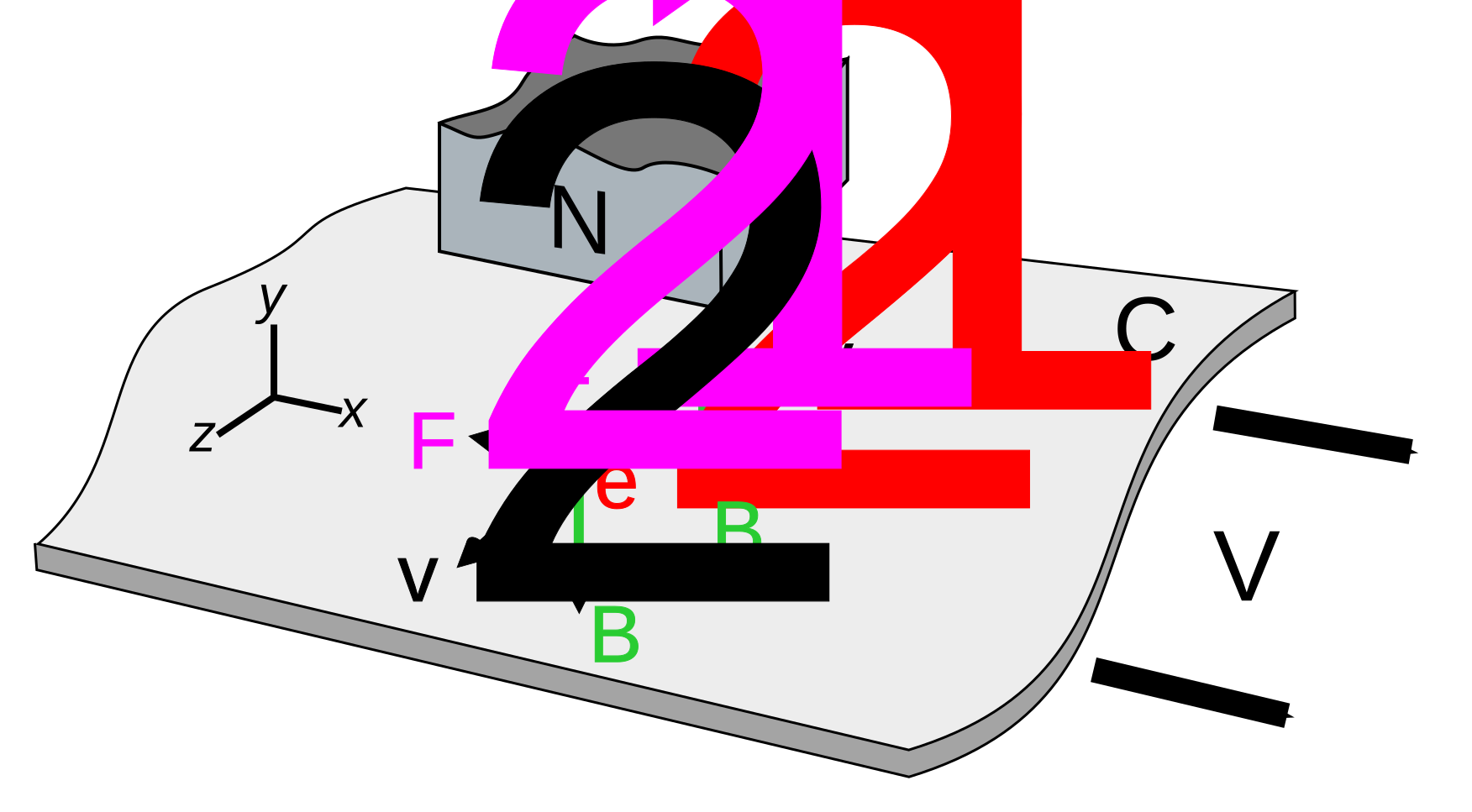
| Описание | Diagram showing the forces on an electron in a metal sheet moving to the right under a magnet <img alt="{\displaystyle \mathbf {N} }" aria-hidden="true" class="mwe-math-fallback-image-inline mw-invert" src="https://wikimedia.org/api/rest_v1/media/math/render/svg/c2f63b6cd6d63ee9b7be0b7e4d14099d7153bd43" style="vertical-align: -0.338ex; width:2.091ex; height:2.176ex;"/>, explaining eddy currents, and where the drag force on the sheet comes from. The red dot <img alt="{\displaystyle \mathbf {e} _{\text{1 |
|---|---|
| Источник | |
| Время создания | |
| Автор или правообладатель | |
| Другие версии файла | — |


}" aria-hidden="true" class="mwe-math-fallback-image-inline mw-invert" src="https://wikimedia.org/api/rest_v1/media/math/render/svg/66e689b14d7dc8bc9592c4acfdaadbd6fc4ddf1f" style="vertical-align: -0.671ex; width:2.279ex; height:2.009ex;"/> shows an electron in the metal under the magnet right after it has undergone a collision, and <img alt="{\displaystyle \mathbf {e} _{\text{2}}}" aria-hidden="true" class="mwe-math-fallback-image-inline mw-invert" src="https://wikimedia.org/api/rest_v1/media/math/render/svg/65b0a74a3ca2ad6eca0a97ad3ef5b62bf3681648" style="vertical-align: -0.671ex; width:2.279ex; height:2.009ex;"/> shows the same electron after it has been accelerated by the magnetic field. On average at <img alt="{\displaystyle \mathbf {e} _{\text{1}}}" aria-hidden="true" class="mwe-math-fallback-image-inline mw-invert" src="https://wikimedia.org/api/rest_v1/media/math/render/svg/66e689b14d7dc8bc9592c4acfdaadbd6fc4ddf1f" style="vertical-align: -0.671ex; width:2.279ex; height:2.009ex;"/> the electron has the same velocity as the sheet <img alt="{\displaystyle \mathbf {v} }" aria-hidden="true" class="mwe-math-fallback-image-inline mw-invert" src="https://wikimedia.org/api/rest_v1/media/math/render/svg/35c1866e359fbfd2e0f606c725ba5cc37a5195d6" style="vertical-align: -0.338ex; width:1.411ex; height:1.676ex;"/> (black arrow). in the <img alt="{\displaystyle +\mathbf {x} }" aria-hidden="true" class="mwe-math-fallback-image-inline mw-invert" src="https://wikimedia.org/api/rest_v1/media/math/render/svg/54c722029f50f473e7b166a1cf2d689f4960d182" style="vertical-align: -0.505ex; width:3.219ex; height:2.176ex;"/> direction. The magnetic field (<img alt="{\displaystyle \mathbf {B} }" aria-hidden="true" class="mwe-math-fallback-image-inline mw-invert" src="https://wikimedia.org/api/rest_v1/media/math/render/svg/cafb0ef39b0f5ffa23c170aa7f7b4e718327c4d1" style="vertical-align: -0.338ex; width:1.901ex; height:2.176ex;"/>, green arrow) of the magnet's North pole N is directed down in the <img alt="{\displaystyle -\mathbf {y} }" aria-hidden="true" class="mwe-math-fallback-image-inline mw-invert" src="https://wikimedia.org/api/rest_v1/media/math/render/svg/29502381c2d9b0ffcfc7cca4a0db68f77bafaf6a" style="vertical-align: -0.671ex; width:3.219ex; height:2.343ex;"/> direction. The magnetic field exerts a Lorentz force on the electron (pink arrow) of <img alt="{\displaystyle \mathbf {F} _{\text{1}}=-e(\mathbf {v} \times \mathbf {B} )}" aria-hidden="true" class="mwe-math-fallback-image-inline mw-invert" src="https://wikimedia.org/api/rest_v1/media/math/render/svg/b2a3963737a376e4db2e392e6766763886e3cb47" style="vertical-align: -0.838ex; width:16.689ex; height:2.843ex;"/>, where e is the electron's charge. Since the electron has a negative charge, from the right hand rule this is directed in the <img alt="{\displaystyle +\mathbf {y} }" aria-hidden="true" class="mwe-math-fallback-image-inline mw-invert" src="https://wikimedia.org/api/rest_v1/media/math/render/svg/41216c18cd1496a09a8fe3b09917f5e55b2e153f" style="vertical-align: -0.671ex; width:3.219ex; height:2.343ex;"/> direction. At <img alt="{\displaystyle \mathbf {e} _{\text{2}}}" aria-hidden="true" class="mwe-math-fallback-image-inline mw-invert" src="https://wikimedia.org/api/rest_v1/media/math/render/svg/65b0a74a3ca2ad6eca0a97ad3ef5b62bf3681648" style="vertical-align: -0.671ex; width:2.279ex; height:2.009ex;"/> this force gives the electron a component of velocity in the sideways direction (<img alt="{\displaystyle \mathbf {v} _{\text{2}}}" aria-hidden="true" class="mwe-math-fallback-image-inline mw-invert" src="https://wikimedia.org/api/rest_v1/media/math/render/svg/eb310cc9f48a386eb16f8c6cf0db7d928e7f2615" style="vertical-align: -0.671ex; width:2.465ex; height:2.009ex;"/>. black arrow) The magnetic field acting on this sideways velocity, then exerts a Lorentz force on the particle of <img alt="{\displaystyle \mathbf {F} _{\text{2}}=-e(\mathbf {v} _{\text{2}}\times \mathbf {B} )}" aria-hidden="true" class="mwe-math-fallback-image-inline mw-invert" src="https://wikimedia.org/api/rest_v1/media/math/render/svg/ea408b4fbfeb67de61c72659299a11331f446144" style="vertical-align: -0.838ex; width:17.743ex; height:2.843ex;"/>. From the right hand rule, this is directed in the <img alt="{\displaystyle -\mathbf {x} }" aria-hidden="true" class="mwe-math-fallback-image-inline mw-invert" src="https://wikimedia.org/api/rest_v1/media/math/render/svg/f0a01370ff50ffc54518e7c4c1199279b0370f68" style="vertical-align: -0.505ex; width:3.219ex; height:2.176ex;"/>, opposite to the velocity <img alt="{\displaystyle \mathbf {v} }" aria-hidden="true" class="mwe-math-fallback-image-inline mw-invert" src="https://wikimedia.org/api/rest_v1/media/math/render/svg/35c1866e359fbfd2e0f606c725ba5cc37a5195d6" style="vertical-align: -0.338ex; width:1.411ex; height:1.676ex;"/> of the metal sheet. This force accelerates the electron giving it a component of velocity opposite to the sheet. Collisions of these electrons with the atoms of the sheet exert a drag force on the sheet.
| источник = Own work | время создания = 2020-11-21 | автор = Chetvorno — Лицензия: CC0 (Creative Commons Zero, Public Domain Dedication) http://creativecommons.org/publicdomain/zero/1.0/deed.en }} Источник файла — сайт Wikimedia Commons, куда он был загружен под одной из свободных лицензий ( https://commons.wikimedia.org/wiki/File:Eddy_currents_-_explanation_of_drag_force.svg ). Авторов, работавших над этим файлом см. в истории файла: https://commons.wikimedia.org/w/index.php?title=File:Eddy_currents_-_explanation_of_drag_force.svg&action=history


В общем случае в статьях энциклопедии Руниверсалис файлы используются в соответствии со статьёй 1274 Гражданского кодекса Российской Федерации.
История файла
Нажмите на дату/время, чтобы увидеть версию файла от того времени.
| Дата/время | Миниатюра | Размеры | Участник | Примечание | |
|---|---|---|---|---|---|
| текущий | 08:16, 10 октября 2023 | | 1752 × 967 (33 КБ) | Я, робот (обсуждение | вклад) | == Описание == {{Изображение | описание = Diagram showing the forces on an [https://en.wikipedia.org/wiki/electron electron] in a metal sheet moving to the right under a magnet <span class="mwe-math-element"><span class="mwe-math-mathml-inline mwe-math-mathml-a11y" style="display: none;"><math alttext="{\displaystyle \mathbf {N} }" xmlns="http://www.w3.org/1998/Math/MathML"><semantics><mrow class="MJX-TeXAtom-ORD"><mstyle displaystyle="true" scriptlevel="0"><mrow class="MJX-TeXAtom-ORD"><mi... |
Вы не можете перезаписать этот файл.
Использование файла
Следующий файл является дубликатом этого файла (подробности):

- Файл:Eddy currents - explanation of drag force.svg на общем хранилище
Следующая страница использует этот файл:
