


Файл:Beta Lyrae - CHARA.gif
Beta_Lyrae_-_CHARA.gif (272 × 272 пкс, размер файла: 446 КБ, MIME-тип: image/gif, закольцованный, 48 фреймов, 9,6 с)
Описание
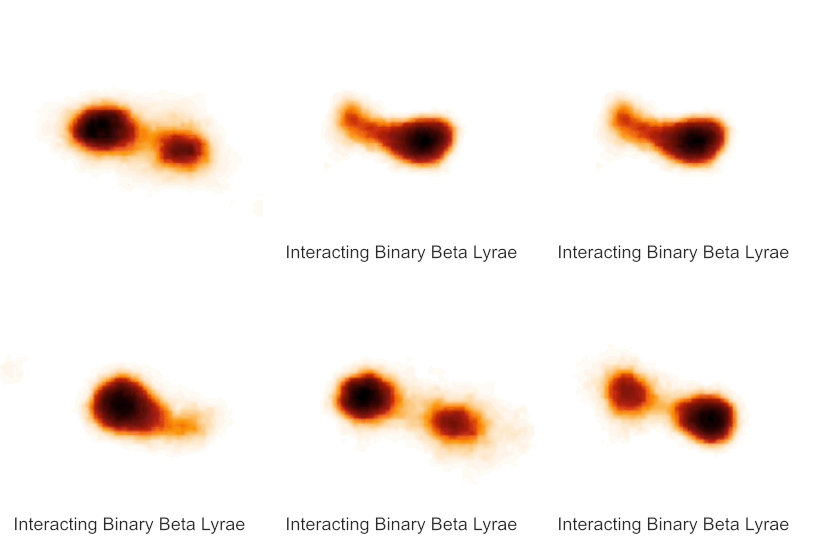
| Описание | Beta Lyrae is an interacting and eclipsing binary where material is gravitationally pulled away from one star and accretes on to the surface of the companion. The system has an orbital period of 13 days. Using the CHARA Array, researchers obtained images of beta Lyrae showing the mass donor and the thick disk surrounding the mass gainer. The donor is brighter and appears elongated; this is the first direct detection of photospheric tidal distortion due to Roche lobe filling. The disk component is fainter and more elongated than the donor.
Reference: Zhao et al. 2008, ApJ, 684, 95 |
|---|---|
| Источник | http://chara.gsu.edu/astronomers/science-highlights/55-eclipsing-binaries |
| Время создания | 2008-08-21 |
| Автор или правообладатель | Center for High Angular Resolution Astronomy — Лицензия: CC0 (Creative Commons Zero, Public Domain Dedication) http://creativecommons.org/publicdomain/zero/1.0/deed.en |
| Другие версии файла | — |
Источник файла — сайт Wikimedia Commons, куда он был загружен под одной из свободных лицензий ( https://commons.wikimedia.org/wiki/File:Beta_Lyrae_-_CHARA.gif ). Авторов, работавших над этим файлом см. в истории файла: https://commons.wikimedia.org/w/index.php?title=File:Beta_Lyrae_-_CHARA.gif&action=history


В общем случае в статьях энциклопедии Руниверсалис файлы используются в соответствии со статьёй 1274 Гражданского кодекса Российской Федерации.
История файла
Нажмите на дату/время, чтобы увидеть версию файла от того времени.
| Дата/время | Миниатюра | Размеры | Участник | Примечание | |
|---|---|---|---|---|---|
| текущий | 12:45, 8 августа 2023 | | 272 × 272 (446 КБ) | I, Robot (обсуждение | вклад) | == Описание == {{Изображение | описание = Beta Lyrae is an interacting and eclipsing binary where material is gravitationally pulled away from one star and accretes on to the surface of the companion. The system has an orbital period of 13 days. Using the CHARA Array, researchers obtained images of beta Lyrae showing the mass donor and the thick disk surrounding the mass gainer. The donor is brighter and appears elongated; this is the first direct detection of photospheric tidal distortio... |
Вы не можете перезаписать этот файл.
Использование файла
Следующие 2 страницы используют этот файл:
